The Kernel Boot Process
The previous post explained how computers boot up right up to the point where the boot loader, after stuffing the kernel image into memory, is about to jump into the kernel entry point. This last post about booting takes a look at the guts of the kernel to see how an operating system starts life. Since I have an empirical bent I’ll link heavily to the sources for Linux kernel 2.6.25.6 at the Linux Cross Reference. The sources are very readable if you are familiar with C-like syntax; even if you miss some details you can get the gist of what’s happening. The main obstacle is the lack of context around some of the code, such as when or why it runs or the underlying features of the machine. I hope to provide a bit of that context. Due to brevity (hah!) a lot of fun stuff – like interrupts and memory – gets only a nod for now. The post ends with the highlights for the Windows boot.
At this point in the Intel x86 boot story the processor is running in real-mode, is able to address 1 MB of memory, and RAM looks like this for a modern Linux system:
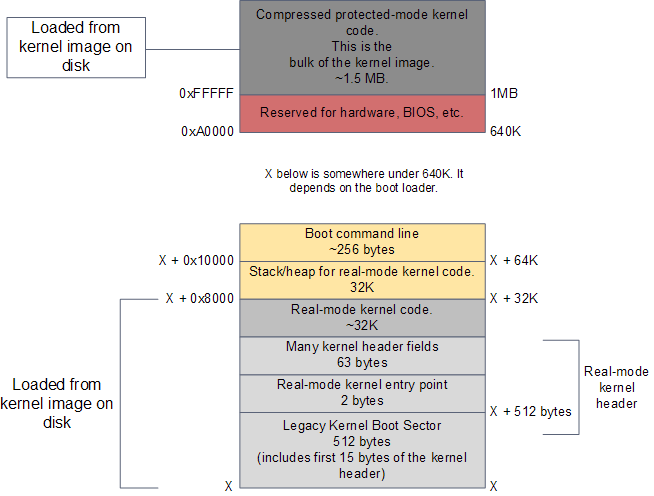
RAM contents after boot loader is done
The kernel image has been loaded to memory by the boot loader using the BIOS disk I/O services. This image is an exact copy of the file in your hard drive that contains the kernel, e.g. /boot/vmlinuz-2.6.22-14-server. The image is split into two pieces: a small part containing the real-mode kernel code is loaded below the 640K barrier; the bulk of the kernel, which runs in protected mode, is loaded after the first megabyte of memory.
The action starts in the real-mode kernel header pictured above. This region of memory is used to implement the Linux boot protocol between the boot loader and the kernel. Some of the values there are read by the boot loader while doing its work. These include amenities such as a human-readable string containing the kernel version, but also crucial information like the size of the real-mode kernel piece. The boot loader also writes values to this region, such as the memory address for the command-line parameters given by the user in the boot menu. Once the boot loader is finished it has filled in all of the parameters required by the kernel header. It’s then time to jump into the kernel entry point. The diagram below shows the code sequence for the kernel initialization, along with source directories, files, and line numbers:
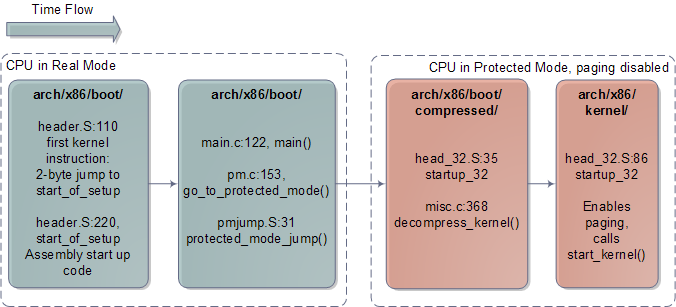
Architecture-specific Linux Kernel Initialization
The early kernel start-up for the Intel architecture is in file arch/x86/boot/header.S. It’s in assembly language, which is rare for the kernel at large but common for boot code. The start of this file actually contains boot sector code, a left over from the days when Linux could work without a boot loader. Nowadays this boot sector, if executed, only prints a “bugger_off_msg” to the user and reboots. Modern boot loaders ignore this legacy code. After the boot sector code we have the first 15 bytes of the real-mode kernel header; these two pieces together add up to 512 bytes, the size of a typical disk sector on Intel hardware.
After these 512 bytes, at offset 0×200, we find the very first instruction that runs as part of the Linux kernel: the real-mode entry point. It’s in header.S:110 and it is a 2-byte jump written directly in machine code as 0x3aeb. You can verify this by running hexdump on your kernel image and seeing the bytes at that offset – just a sanity check to make sure it’s not all a dream. The boot loader jumps into this location when it is finished, which in turn jumps to header.S:229 where we have a regular assembly routine called start_of_setup. This short routine sets up a stack, zeroes the bss segment (the area that contains static variables, so they start with zero values) for the real-mode kernel and then jumps to good old C code at arch/x86/boot/main.c:122.
main() does some house keeping like detecting memory layout, setting a video mode, etc. It then calls go_to_protected_mode(). Before the CPU can be set to protected mode, however, a few tasks must be done. There are two main issues: interrupts and memory. In real-mode the interrupt vector table for the processor is always at memory address 0, whereas in protected mode the location of the interrupt vector table is stored in a CPU register called IDTR. Meanwhile, the translation of logical memory addresses (the ones programs manipulate) to linear memory addresses (a raw number from 0 to the top of the memory) is different between real-mode and protected mode. Protected mode requires a register called GDTR to be loaded with the address of a Global Descriptor Table for memory. So go_to_protected_mode() calls setup_idt() and setup_gdt() to install a temporary interrupt descriptor table and global descriptor table.
We’re now ready for the plunge into protected mode, which is done by protected_mode_jump, another assembly routine. This routine enables protected mode by setting the PE bit in the CR0 CPU register. At this point we’re running with paging disabled; paging is an optional feature of the processor, even in protected mode, and there’s no need for it yet. What’s important is that we’re no longer confined to the 640K barrier and can now address up to 4GB of RAM. The routine then calls the 32-bit kernel entry point, which is startup_32 for compressed kernels. This routine does some basic register initializations and calls decompress_kernel(), a C function to do the actual decompression.
decompress_kernel() prints the familiar “Decompressing Linux…” message. Decompression happens in-place and once it’s finished the uncompressed kernel image has overwritten the compressed one pictured in the first diagram. Hence the uncompressed contents also start at 1MB. decompress_kernel() then prints “done.” and the comforting “Booting the kernel.” By “Booting” it means a jump to the final entry point in this whole story, given to Linus by God himself atop Mountain Halti, which is the protected-mode kernel entry point at the start of the second megabyte of RAM (0×100000). That sacred location contains a routine called, uh, startup_32. But this one is in a different directory, you see.
The second incarnation of startup_32 is also an assembly routine, but it contains 32-bit mode initializations. It clears the bss segment for the protected-mode kernel (which is the true kernel that will now run until the machine reboots or shuts down), sets up the final global descriptor table for memory, builds page tables so that paging can be turned on, enables paging, initializes a stack, creates the final interrupt descriptor table, and finally jumps to to the architecture-independent kernel start-up, start_kernel(). The diagram below shows the code flow for the last leg of the boot:
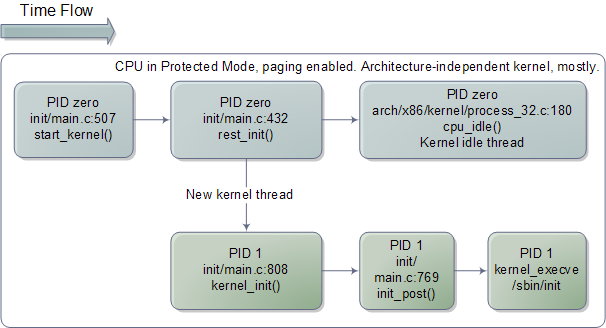
Architecture-independent Linux Kernel Initialization
start_kernel() looks more like typical kernel code, which is nearly all C and machine independent. The function is a long list of calls to initializations of the various kernel subsystems and data structures. These include the scheduler, memory zones, time keeping, and so on. start_kernel() then calls rest_init(), at which point things are almost all working. rest_init() creates a kernel thread passing another function, kernel_init(), as the entry point. rest_init() then calls schedule() to kickstart task scheduling and goes to sleep by calling cpu_idle(), which is the idle thread for the Linux kernel. cpu_idle() runs forever and so does process zero, which hosts it. Whenever there is work to do – a runnable process – process zero gets booted out of the CPU, only to return when no runnable processes are available.
But here’s the kicker for us. This idle loop is the end of the long thread we followed since boot, it’s the final descendent of the very first jump executed by the processor after power up. All of this mess, from reset vector to BIOS to MBR to boot loader to real-mode kernel to protected-mode kernel, all of it leads right here, jump by jump by jump it ends in the idle loop for the boot processor, cpu_idle(). Which is really kind of cool. However, this can’t be the whole story otherwise the computer would do no work.
At this point, the kernel thread started previously is ready to kick in, displacing process 0 and its idle thread. And so it does, at which point kernel_init() starts running since it was given as the thread entry point. kernel_init() is responsible for initializing the remaining CPUs in the system, which have been halted since boot. All of the code we’ve seen so far has been executed in a single CPU, called the boot processor. As the other CPUs, called application processors, are started they come up in real-mode and must run through several initializations as well. Many of the code paths are common, as you can see in the code for startup_32, but there are slight forks taken by the late-coming application processors. Finally, kernel_init() calls init_post(), which tries to execute a user-mode process in the following order: /sbin/init, /etc/init, /bin/init, and /bin/sh. If all fail, the kernel will panic. Luckily init is usually there, and starts running as PID 1. It checks its configuration file to figure out which processes to launch, which might include X11 Windows, programs for logging in on the console, network daemons, and so on. Thus ends the boot process as yet another Linux box starts running somewhere. May your uptime be long and untroubled.
The process for Windows is similar in many ways, given the common architecture. Many of the same problems are faced and similar initializations must be done. When it comes to boot one of the biggest differences is that Windows packs all of the real-mode kernel code, and some of the initial protected mode code, into the boot loader itself (C:\NTLDR). So instead of having two regions in the same kernel image, Windows uses different binary images. Plus Linux completely separates boot loader and kernel; in a way this automatically falls out of the open source process. The diagram below shows the main bits for the Windows kernel:
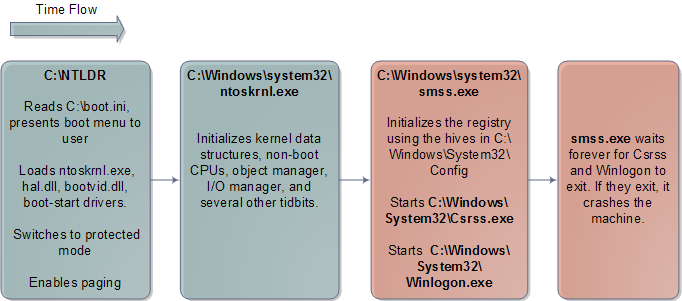
Windows Kernel Initialization
The Windows user-mode start-up is naturally very different. There’s no /sbin/init, but rather Csrss.exe and Winlogon.exe. Winlogon spawns Services.exe, which starts all of the Windows Services, and Lsass.exe, the local security authentication subsystem. The classic Windows login dialog runs in the context of Winlogon.
This is the end of this boot series. Thanks everyone for reading and for feedback. I’m sorry some things got superficial treatment; I’ve gotta start somewhere and only so much fits into blog-sized bites. But nothing like a day after the next; my plan is to do regular “Software Illustrated” posts like this series along with other topics. Meanwhile, here are some resources:
- The best, most important resource, is source code for real kernels, either Linux or one of the BSDs.
- Intel publishes excellent Software Developer’s Manuals, which you can download for free.
- Understanding the Linux Kernel is a good book and walks through a lot of the Linux Kernel sources. It’s getting outdated and it’s dry, but I’d still recommend it to anyone who wants to grok the kernel. Linux Device Drivers is more fun, teaches well, but is limited in scope. Finally, Patrick Moroney suggested Linux Kernel Development by Robert Love in the comments for this post. I’ve heard other positive reviews for that book, so it sounds worth checking out.
- For Windows, the best reference by far is Windows Internals by David Solomon and Mark Russinovich, the latter of Sysinternals fame. This is a great book, well-written and thorough. The main downside is the lack of source code.
[Update: In a comment below, Nix covered a lot of ground on the initial root file system that I glossed over. Thanks to Marius Barbu for catching a mistake where I wrote "CR3" instead of GDTR]
Comments
97 Responses to “The Kernel Boot Process”
Leave a Reply
Great article, I loved it. Thanks.
What tool do you use to generate these cute schema and illustrations ?
Excellent article, thanks!
> Wow, that sounds very complicated. Is the process really that complicated?
No, he made it all up. What were you thinking?!
Only for people that spam.
@FAb: cool, you’re welcome. The diagrams were all done in Visio 2007.
@Frank: thanks for reading.
@xxx: hahaha.
@Maurice: Yea, that comment cum URL is borderline. Sigh.
I have been seeing that ultimate anonymity crap come up in so many comment threads lately. Funny, always under different URL’s too. Other than that, great article (although I really could have used it about two weeks ago when trying to fix some weird boot errors, ah well, muddled through them in the end)
Alright, then I’m deleting it. Thanks for the heads up.
Kick ass article, I enjoyed it!
It fills in a few blanks I got in my vague knowledge of this process, and being pretty humble in my knowledge, don’t think you under-complicated it at all – however I now am curious for more detail.
Oh, yeah. Did an upgrade which crashed and it deleted /sbin/init – at least now I know what step of the process that was … in hindsight. LOL
Keep it up!
H
La secuencia de inicio en el kernel Linux (ingles)…
Gran explicación de cómo se inicia el sistema operativo Linux. Quizá es un poco compleja para los no informático pero me ha parecido interesante….
what software do you use to create those nice diagrams?
[...] startup of a linux kernel primarily, but describes how the windows kernel is different in the end. Link __________________ BIG BROTHERWe apologize for the inconvenience IS [...]
Nice writeup, subscribed!
However, there’s a little error in the article:
“Protected mode requires a register called CR3 to be loaded with the address of a Global Descriptor Table for memory”.
CR3 is the PDBR (Page Directory Base Register, holds the physical address of the page directory) so is only needed when paging is enabled. The Global Descriptor Table is loaded into GDTR (special register just like IDTR) by the lgdt instruction.
[...] Kernel Boot Process Diary of a failed Startup Who needs a Computer Science Degree when there’s Wikipedia Programmer Insecurity Metaclass Programming in Python [...]
I also highly recommend Linux Kernel Development by Robert Love
Much less dry then Understanding the Linux Kernel, and also more recent.
http://www.amazon.com/Linux-Kernel-Development-Novell-Press/dp/0672327201
@Dreamtorrent: thanks
@kaizen: MS Visio 2007. I use ‘themes’, which make it easy to make decent-looking stuff.
@Marius: thanks for catching it. Fixed in the text.
@Patrick: thanks for the reference, I’ll add it to the text as well.
Thanks for the well researched post! I especially liked the links to the specific functions in the Linux kernel source.
I’ve subscribed to your feed and look forward to upcoming posts.
Keep up the great work!
The Kernel Boot Process Explained: 2.6.25.6…
The kernel boot process for linux 2.6.25.6 explained…
Can not have better then this, awesome !!!
Thanks.
[...] The Kernel Boot Process : Gustavo Duarte the birth of “life” (tags: linux kernel boot bootloader) [...]
This would be infinitely more useful if you showed the Windows boot process first since that is what most computers actually use. And THEN at the end you can use the academic Linux boot process for completeness. Nope, sorry, this gets a thumbs down from me on SU. Next.
Great trifecta of boot-up articles, thanks!
Awesome article, Thank you !
Thank you all for reading and for the feedback.
[...] The kernel boot process. [...]
Very good article. I love the ‘illustrated’ style you used.
Incidentally, I’ve just skimmed your entire blog, and I’m rather impressed. Not only is your English quite good (a concern you voiced in one post – IMO, reading TCP/IP Illustrated is a damn good start if you’re doing technical writing
, but _every_ post you’ve written so far looks interesting and substantial.
Keep up the good work. I’ll be back.
-ben
[...] Chipsets and the Memory Map, How Computers Boot Up i The Kernel Boot Process Za one koje zanima kako računala rade iznutra, Gustavo Duarte je napisao seriju članaka čiji je [...]
[...] Nguồn : http://duartes.org/gustavo/blog/post/kernel-boot-process [...]
Muito bom gustavo!
Posso traduzir e colocar no meu blog, e uma referência p/ cá?
[]´s
It’s fake, photoshopped. Look, you can see the blurred pixel area
Great article, definitely the best explanation about boot up flow I’ve found the graphics are the top.
Good work.
@Ben: thanks a ton
I’m a huge fan of the W. Richard Stevens books as well, so I fully agree they’re a damn good start. What I meant by the English comment was that I sometimes feel a lack of non-tech reading has hampered my English. Say, when it’s time to come up with a metaphor or the ‘right word’, that kind of thing. But I’ve been here in the US for a few years now, so it’s less of a problem now.
@Christian: obrigado, e pode traduzir sem problemas, desde que tenha o link. Se vc quiser eu posse te mandar os arquivos Visio 2007 para as imagens ou traduzi-las pra voce.
@eto: hahaha, fake computer pr0n. Anyhow, thanks for the kind words
[...] linux kernel boot process; http://duartes.org/gustavo/blog/post/kernel-boot-process The previous post explained how computers boot up right up to the point where the boot loader, [...]
Olá Gustavo!
Pode deixar que eu vou colocar o link sim.
Por favor, me envie os arquivos para eu traduzir.
Quando eu terminar de traduzir tudo, eu mando para você dar uma revisada, vc quer?
Obrigado e forte abraço!
Christian
Excellent article, but I have one question:
If decompression happens in-place, how come the compressed parts don’t get overwritten by uncompressed data before those compressed part are read?
[...] The kernel boot process [...]
@Idefix: the compressed image is temporarily moved up in memory a notch, creating a ‘buffer zone’ between the place in memory where uncompressed contents are being written to and the place where compressed contents are read from.
The code is here.
cheers
Hi Gustavo,
The whole process of computer boot up from memory map to kernel loading was amazing. I linked your articles to http://www.osnews.com/story/20064/Computer_Boot_Up_Process. It is refreshing to see articles that are succinct and resourceful.
Thank You!
This three articles show something very complicated in easy way. Good job!
I was looking for such text for a long time.
-mojes
“In real-mode the interrupt vector table for the processor is always at memory address 0, whereas in protected mode the location of the interrupt vector table is stored in a CPU register called IDTR” – This is not true. Also in real mode, the CPU uses the IDTR to locate the (real mode) IVT. In practice, the IDTR is always set to 0, but it could be changed.
@Amjith: thank you for the kind words and also for the link. I got a ton of traffic from you.
@Mojes: you’re very welcome!
@Kilian: Thanks for noting this. I’ll change the language to be more accurate.
thanks alot , that was great
i will be so much glad
))))) if you post more and more such sweets.
Well explained. I think I got it, despite the fact that I didn’t know much about this topic.
So, thank you
Frederik
P.S.: More posts on this topic will be appreciated
[...] segmentation, protection, and paging in Intel-compatible (x86) computers, in the spirit of the boot series, as the next step down the path of how kernels work. As usual, I’ll link to Linux kernel [...]
Hi Gustavo,
that was great article, i had a question , is it possible to monitor the boot parameters beacause of finding out if everything is ok or not , such as :
- MBR parameters(of its code and partition table) and their place in memory , and which of them are still in RAM or removed.
actually , I would like to program it under a program to use it as a utility in shell environment , and honestly i don’t khow what must i do , and even i don’t khow that it must be a assembly program or it can be C one,
I really will be so much thankful if you lead me in this way,
thanks a lot,
-Kimia
hi duartes
you have done a very good job..
I have few queries : Is there any fixed size in memory reserved for user and kernel space? otherwise how can we know the size of memory used by kernel and user application?
@Kimia: Nearly all of the real-mode data from the kernel is wiped out once the protected mode part starts running, so some of these early parameters are lost.
You can however read the MBR and partition table right off of the disk, by reading for example a device like /dev/hdxx or /dev/sbxx corresponding to your hard disk. It would not be too hard to read the partition table and MBR doing that. You might want to read the source code for fdisk() and other Linux disk utilities.
Does this help?
@kavitha: There is memory that the kernel reserves for itself, yes. But there’s also dynamic memory that the kernel allocates and frees as it runs. The kernel keeps a database of all of the memory and how it has been distributed (which process owns it, etc).
I’ll write a post on memory this weekend that will cover some of this.
Hi Gustavo,
first of all , thanks alot of your attention and help.
I see, so as you said i can read from disk , but unfortunetly i don’t know exactly what cammand must be using to read first sector from disk in linux, i’m new to linux system programming and so i need so much help in this field ,
would you please guide me to a good way and reference to know more about this, i just know rare and not implemented khowledge in real systems and i’m new to this world with hungry mind,
best regards,
Kimia
@Kimia: no problem at all. Regarding reading from the disk, it’s Unix tradition to expose hardware devices as magic files in the filesystem, usually under directory /dev
Many devices are exposed there as files, including disks. The exact name of the file depends on the nature of the device (hard disk, USB disk, scanner, sound card, etc), the bus (ide, scsi, sata, usb, etc), the order of the device (1st hard drive on bus, 2nd, etc).
So to read the hard drive, you’d need to find the right device, and then you can use regular C functions like open(), read() to read raw bytes out of disk.
However, what I _really_ suggest you do is _read source code_. It’s one of the _best_ ways to learn, and in this case there are tools that do exactly what you want (MBR and partition table manipulation) and whose code is open source. So get yourself the code for Linux fdisk, maybe the GRUB configuration installer, and read the code. It can teach you a lot.
Of course, you need some books too. My favorite Unix author was W. Richard Stevens, he’s got some great books, but sadly he died and the books haven’t been updated. Look in Amazon for his books, maybe see what the commenters are saying, and find some 5-star books on Unix programming.
hope this helps,
gustavo
I really enjoyed this article and it is a very good one to understand the kernel boot process. Thank you very much for this wonderful article that too in simplified form.
Hola Gustavo, estaba leyendo tu articulo a ver si me aclaraba algunas cosas sobre el proceso de arranque del kernel, ya que soy un poco nuevo en estos menesteres.
Estoy trabajando con un sistema empotrado y quiero actualizar el kernel. Lo he compilado y se me ha generado una imagen del kernel y otro archivo con el sistema de ficheros rootfs.ext2. Mi pregunta es, ¿es necesario que almacene los dos en la flash de mi sistema empotrado? o basta con la imagen del kernel solo?
He tratado de arrancar mi nuevo kernel y empieza a descomprimir pero de da un panic
Kernel panic – not syncing: VFS: Unable to mount root fs on unknown-block(0,0)
A lo mejor me puedes aclarar un poco como funciona esto. Estoy un poco perdido…
Gracias por adelantado
Fantastic article!!! I love it!!!!
nice details about kernel boot-up process. Never found better then this. Thank you.
[...] The Kernel Boot Process by Gustavo Duarte explains the Linux kernel boot process on an x86 platform. Very well written with descriptive and good looking diagrams. [...]
Hi Gustavo again,
thanks again and again, this time because of your helpful advices and guideline that helped me alot.
thank you very much !
Hi, thanks for this great work.
I am trying to read MBR using linux 2.6 kernel.
I need a source code for fdisk utility for intel x86 architecture.
Could you please guide me to the correct link to follow ?
@Gautam:
The easiest way to do it is to just install source packages for the package that contains fdisk. Not sure which distro you have, but you would need to:
1. Find which package fdisk came from (rpm or yum or apt should be able to tell you)
2. Install the source package that corresponds to that package. There’s a 1-to-1 correspondence between binary packages and source packages.
I think in Debian-based distros the package is util-linux, see here:
http://packages.qa.debian.org/u/util-linux.html
The FSF has an fdisk project too, but I’m not sure if it’s the same thing because they say they provide an alternative to util-linux fdisk. The FSF page for their fdisk is here:
http://www.gnu.org/software/fdisk/
But go with the distro’s source.
Gustavo,
Great article. Any idea where the source code for /sbin/init itself is? I’m also interested in the “events” process that is spawned by the “init” process, and would like to know where the source code for that is as well, if you know.
-thanks
Frank
Thanks Man !!!
Awesome article on boot process !!!
One minor additional complexity. The initial root filesystem is, by default, assembled from the contents of the usr/ subdirectory in the kernel source tree (it’s a compressed cpio archive) and linked into the kernel image; alternatively, a compressed filesystem image can be linked into the kernel image or provided in a separate file. Part of the boot process (in init/main.c:do_basic_setup()) involves executing ‘initcalls’, which are stored in an array of pointers to functions to be called at boot time, constructed by the linker. One of these initcalls is init/initramfs.c:populate_rootfs(), which initializes the nonswappable memory-backed filesystem which is always mounted at / (the *real* root filesystem is mounted over the top of it, later on). The rootfs is never unmounted: you can see it as the first entry in /proc/mounts. Then it uncompresses the cpio archive or arranges for the filesystem to be backed by that compressed filesystem image, if either are present, and executes /init on that filesystem, if present, to complete the boot via an ‘early userspace’, chroot to the real root filesystem once it’s found it, and exec the real init. So the job of finding root filesystems is *completely* customizable. You can assemble it from a RAID array with some components pulled over the network if you like (I’ve done this in extremis as part of disaster recovery).
Finally, if that didn’t work and we still don’t have a useful root filesystem with an /sbin/init on it, just before calling init_post(), the system may call prepare_namespace() in init/do_mounts.c. This can try to dig up a root filesystem in a variety of ways: pausing for a configurable amount of time so the user can do something to provide a filesystem, waiting for delayed device probes in case the root filesystem is on some slow-to-start thing like a SCSI disk or a USB key, doing automated RAID probing (somewhat dangerous because it can’t tell if the array it’s assembling is actually made of pieces that are meant to go together: the recommended way to boot off RAID is to use one of the earlier customizable boot processes and run the mdadm tool in there to do the assembly), mounting a block device specified via root= on the kernel command line, or even asking the user to insert a separate floppy containing the root filesystem (I’m not sure *anyone* does this anymore, even in emergencies).
I haven’t got into the half a dozen horrible ways the various early userspaces can signal their completion (echoing the real device numbers into a file in /proc, executing the horrible ‘pivot_root()’ syscall, or just deleting everything on the rootfs and doing a ‘chroot exec /sbin/init’ into the real root filesystem, which is the modern way to boot up because it doesn’t rely on any horrible early-userspace-specific hacks). For more, see Documentation/filesystems/ramfs-rootfs-initramfs.txt and Documentation/initrd.txt in your favourite Linux kernel tree.
Gustavo, thanks a ton for this article. Excellent explanation of a really complex process, even a newbie like me have no problems following.
Big thumbs up!!!
[...] in Intel-compatible (x86) computers, going further down the path of how kernels work. As in the boot series, I’ll link to Linux kernel sources but give Windows examples as well (sorry, I’m ignorant about [...]
[...] In a comment below, Nix covered a lot of ground on the initial root file system that I glossed over. Thanks to Marius [...]
[...] The kernel boot process Posted in IT Teknologi | Leave a Comment [...]
I really liked you article. You have a nice Linux-like sense of humor:)
[quote]This would be infinitely more useful if you showed the Windows boot process first since that is what most computers actually use. And THEN at the end you can use the academic Linux boot process for completeness. Nope, sorry, this gets a thumbs down from me on SU. Next.[/quote]
Yeah, all those Windows kernel hackers out there must be disappointed…
This is *easily* the best article on this subject I’ve been able to find on the web. Very clear, right level of detail (for me, at least), and good references. Thanks very much for writing it.
I infer from some prior comments that you aren’t a native English speaker. Fear not — your English is better than most natives’.
Any chance you’ll write something comparable, describing EFI? (For that matter, I’d like coverage of OSX as well, but suppose that’s asking too much.)
I’ve bookmarked your homepage.
Nice Article. Thank you
Very good article.
Thanks a lot
hi Gustavo,
Thanks for the wonderful article but i have question
what is that “0x3aeb”? i found only “0xeb” (unconditional jump) in header.S. what does that “3a” represent? And why do we need this unconditional jump here? why can’t we put the start_of_setup code directly there?
[...] The Kernel Boot Process [...]
Great explanation of a difficult process that if not easy to understand, I like to give thanks for this good article
[...] The Kernel Boot Process – “The previous post explained how computers boot up right up to the point where the boot loader, after stuffing the kernel image into memory, is about to jump into the kernel entry point. This last post about booting takes a look at the guts of the kernel to see how an operating system starts life…” [...]
Thanks for such a wonderful article.Need more of this article in future.
I’ve bookmarked your homepage.
good job ………
Thanks a ton for not only this but other great articles too.
Hi,
Awesome article Gustav, as usual!
On the ref books topic, I highly recommend this book on drivers: “Essential Linux Device Drivers” by S Venkateswaran.
http://www.amazon.com/Essential-Device-Drivers-Sreekrishnan-Venkateswaran/dp/0132396556/ref=sr_1_2?ie=UTF8&qid=1290086793&sr=8-2
It not only covers the “usual” driver-related topics (and plenty of ‘em) but also gives a fantastic quick look at kernel internals topics most relevant to driver authors.
thxs buddy..!!!!
Try this, very easy to understand
http://www.redhatlinux.info/2010/11/steps-of-boot-process.html
Great article, I loved it. Thanks.
Thank a lot for this article.
nice article. thanks.
DiagOS????…
DiagOS???? DiagOS???? DiagOS ? AMD ???????????????????????OS??? ???????????????? SuSE Linux 9…….
Really Nice Article.
I have a doubt.
The decompression routines will also be a part of the Compressed kernel Image. These routines itself need to be decompressed.
How does this happen?
Thanks in advance.
Hi,
which tool you used for drawing the image of your blog’s article?
You know, all these are so beautiful!
Thanks for your sharing Linux knowledge..
Nice job, Gustavo.
I discovered your blog after doing my own trace through the kernel (using a JTAG on my PowerPC-based platform).
What I couldn’t find was which thread (if any) does the scheduler actually run in? It must be able to pre-empt other threads so I assume it is run in some sort of high-priority parent thread?
Let me know if you find the answer…
Cheers,
Daniel
Thank u for this article…it helped me a lot…..
[...] descrição do que acontece "under the hood" no kernel, pode dar uma lida no artigo do Gustavo Duarte, da IBM DeveloperWorks e do [...]
Can you explain a bit about booting Linux in VirtualBox.
could you explain how C language program can operate during booting. whether we have a compiler here! ( i bet it e xist) . So what going on. thanks for your help!
and i have a question whether i can know about meaning of linux kernel file. what should I do to become a Linux developer
[...] http://duartes.org/gustavo/blog/post/kernel-boot-process [...]
Really great document .. i am fortunate that i have gone through this …
Thank you very much
Awesome article for a struggling “Operating Systems Concepts” student like myself to read!!!!
excellent article.thanks
Please keep on writing this type of documents. It is really helpful.
[...] In a comment below, Nix covered a lot of ground on the initial root file system that I glossed over. Thanks to Marius [...]
Excellent summary!
Wow, that’s what I was exploring for, what a information! existing here at this website, thanks admin of this web site.